
Learn · Infection prevention
Break the chain of infection in the newborn unit
Every infection in a newborn unit travels along a chain: where the germ lives, how it travels, how it gets in, and a baby who cannot defend themselves. Break any one link, and the infection stops.
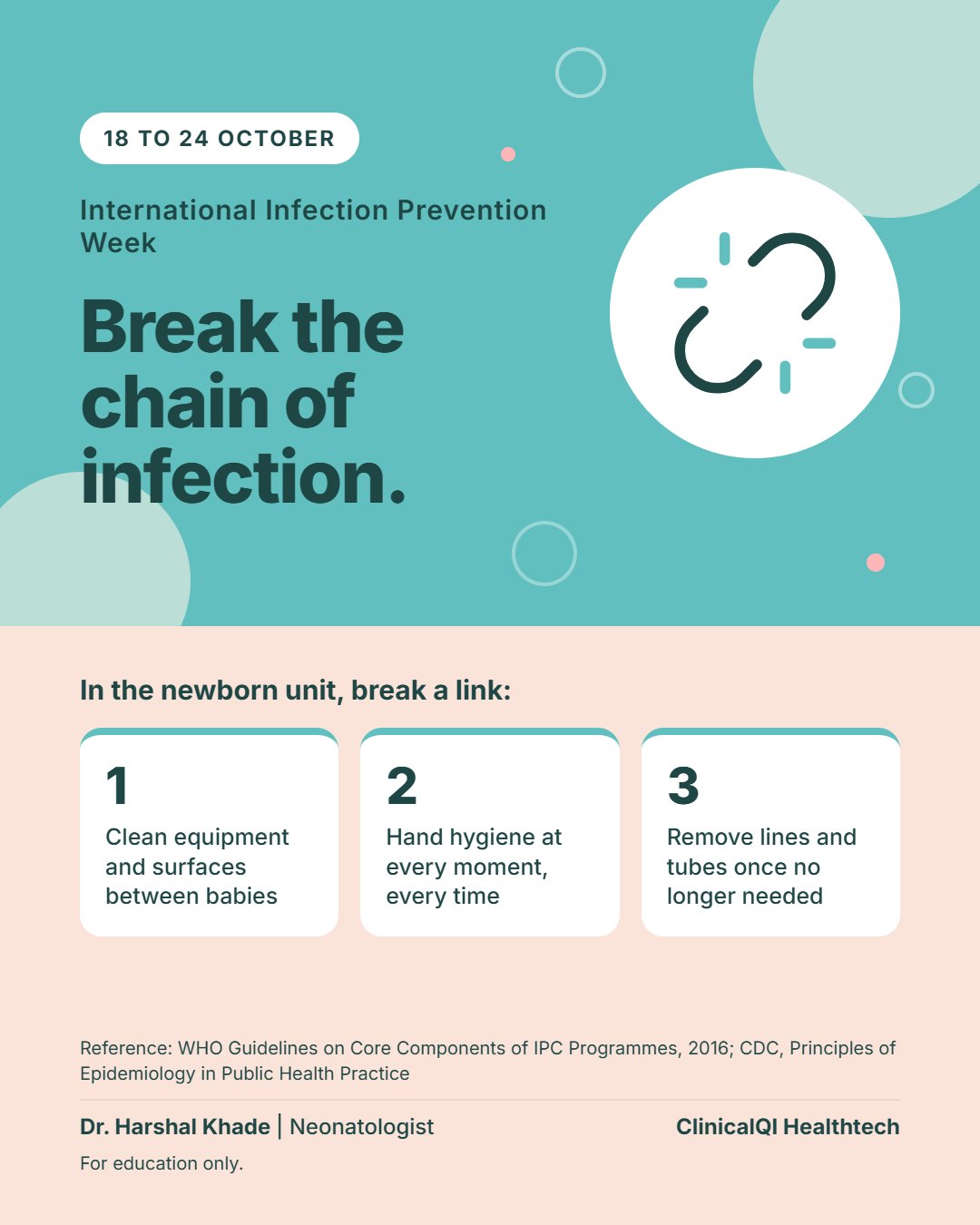
This week is International Infection Prevention Week (18 to 24 October).
Every infection in a newborn unit travels along a chain: where the germ lives, how it travels, how it gets in, and a baby who cannot defend themselves.
Break any one link, and the infection stops.
The links in the chain
Infection control teaching describes a chain of six links: the germ itself, the place where it lives (the reservoir), the way it leaves that place, the way it travels, the way it enters the body, and a person who is susceptible. In a newborn unit, each link has a familiar face:
- Where germs live: hands, shared equipment, surfaces around the cot and other shared items.
- How they travel: most often on the hands of the people caring for babies, and on equipment moved from one baby to the next.
- How they get in: through breaks in the skin, and through intravenous lines, umbilical lines and breathing tubes.
- Who is at risk: newborns, especially preterm babies, whose immune defences and skin are still immature.
How to break a link
- Clean equipment and surfaces between babies.
- Clean your hands at every moment, every time.
- Use aseptic technique for every line, tube and injection.
- Remove lines and tubes as soon as they are no longer needed.
WHO's five moments for hand hygiene: before touching a baby, before a clean or aseptic procedure, after a risk of exposure to body fluids, after touching a baby, and after touching the baby's surroundings.
Common gaps in practice
- Steps get skipped at night and at the busiest times.
- Shared items, such as stethoscopes, move from cot to cot without cleaning.
- Lines and tubes stay in place out of habit, without a daily check of whether they are still needed.
- Hands are cleaned, but not at the right moment, such as just before touching a line.
A short checklist for your unit
- Keep hand rub within reach of every cot.
- Clean shared equipment between babies, and mark what has been cleaned.
- Review every line and tube daily and ask whether it is still needed.
- Use aseptic technique every time a line is accessed.
- Observe hand hygiene on every shift, including nights, and share the results with the team.
Questions and answers
What is the chain of infection?
It describes how an infection spreads: a germ, the place it lives, the way it leaves, the way it travels, the way it enters the body, and a susceptible person. Breaking any one link stops the infection.
Why are newborns at higher risk of infection in hospital?
Their immune defences and skin are still immature, especially in preterm babies, and many need lines and tubes that bypass the body's natural barriers.
Which link is easiest to break?
The way germs travel. WHO describes hand hygiene as a primary measure to prevent healthcare-associated infection, and it is in every staff member's hands, on every shift.
Why remove lines and tubes as soon as possible?
Every day a line or tube stays in place is another day a germ can use it to enter the body. A daily check of whether each device is still needed is a standard part of infection prevention.
A question for your unit
Which link is hardest to hold in your unit, especially on night shifts?
Join the discussion on LinkedInFor education only. Follow your institutional protocol.
References
- World Health Organization. Guidelines on Core Components of Infection Prevention and Control Programmes at the National and Acute Health Care Facility Level, 2016.
- Centers for Disease Control and Prevention. Principles of Epidemiology in Public Health Practice.
- World Health Organization. WHO Guidelines on Hand Hygiene in Health Care, 2009.

Dr. Harshal Khade is a neonatologist in Nagpur, India, with over nine years of clinical experience across neonatal intensive care, tele-ICU and paediatric practice, and the founder of ClinicalQI Healthtech LLP.