
Learn · Infection surveillance
A true zero needs both halves: reading a zero infection rate
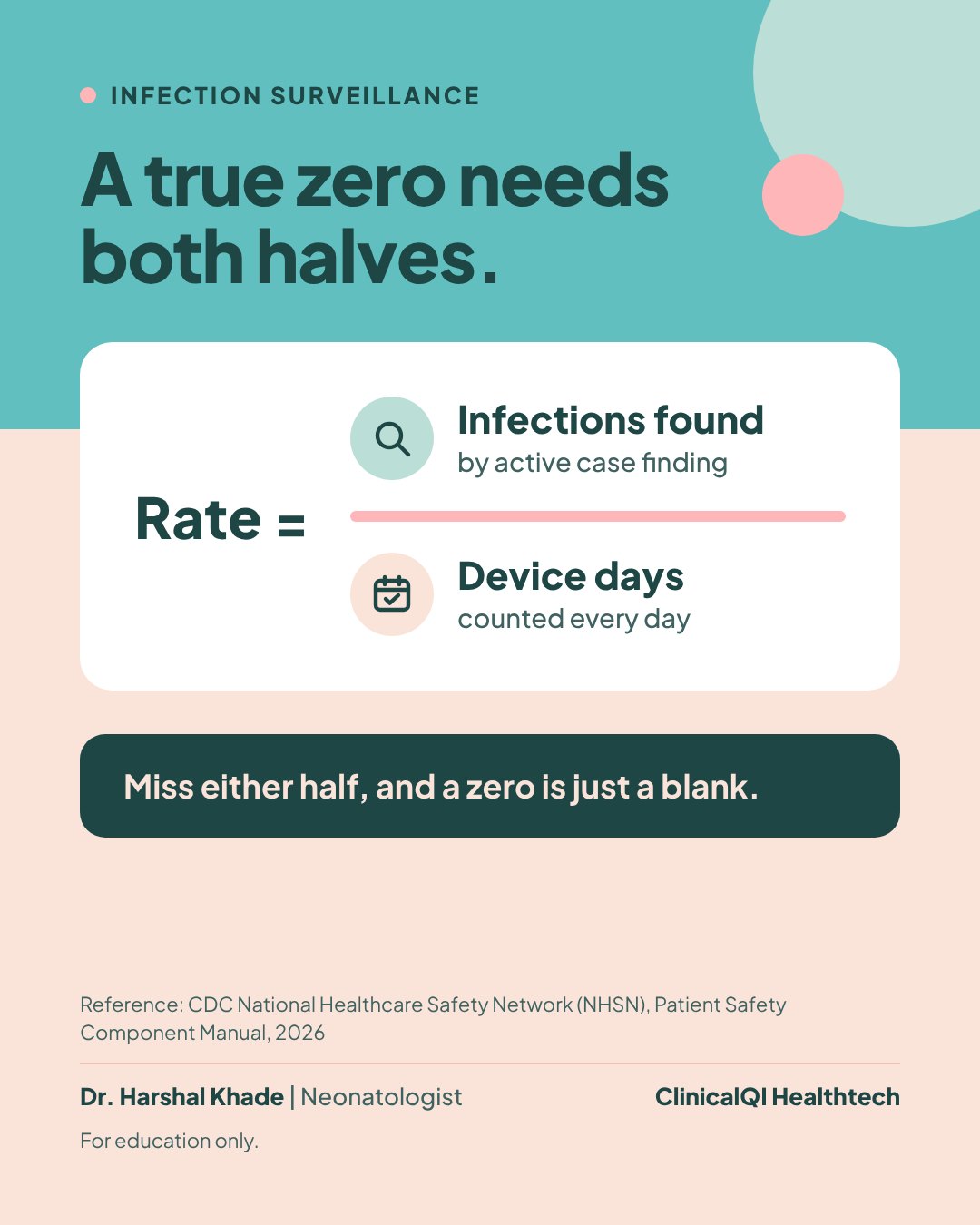
A blank infection register is not the same as an infection rate of zero. A true zero needs active case finding against a standard surveillance definition, a daily count of device days or patient days, and the same definitions applied the same way every month.
"Zero infections this month." Is that good news, or just no news?
A blank infection register is easy to read as a rate of zero. They are not the same thing.
How an infection rate is calculated
An infection rate has two halves. The top half is the number of infections found. The bottom half is how long babies were at risk: for device-associated infections, the number of device days, such as central line days or ventilator days. A device day is one baby with that device in place on one day, counted at the same time every day.
In the CDC National Healthcare Safety Network (NHSN) method, the rate is the number of infections divided by the number of device days, multiplied by 1,000. Without both halves, there is no rate at all.
What a true zero needs
- Active case finding: looking for every infection that meets a standard surveillance definition, not waiting for someone to report it.
- A denominator: device days or patient days, counted every day.
- Consistency: the same definitions, applied the same way, month after month.
Why a blank register can mislead
- If infections are only recorded when someone reports them, many are missed.
- If cultures are not sent when an infection is suspected, infections cannot be found.
- If different people apply the definitions differently, the numbers are not comparable from month to month.
- If device days are not counted, a rate cannot be calculated, even when infections are recorded.
Without these, "no events recorded" may only mean that no one was looking, or that the definition was never applied.
A short checklist for your unit
- Write down the surveillance definitions your unit uses, and train everyone who applies them.
- Count device days every day, at a fixed time.
- Look for infections actively, for example by reviewing positive culture reports from the laboratory.
- Each month, cross-check the infection register against the laboratory's culture reports.
- Review a month of zero as carefully as a month with a rise.
A real zero is earned through surveillance. It is not the absence of paperwork.
Questions and answers
What is a device day?
One baby with a device in place, such as a central line or a ventilator, on one day. Device days are counted every day, at the same time, and form the bottom half of the infection rate.
Why can a zero infection rate be misleading?
Because a zero only means something if infections were actively looked for using a standard definition, and the days at risk were counted. Otherwise a zero may simply mean no one was looking.
How can a unit check that its zero is a true zero?
Compare the infection register with the laboratory's culture reports, confirm device days were counted every day, and check that the same definitions were applied throughout the month.
A question for your unit
How does your unit check that a zero is a true zero?
Join the discussion on LinkedInFor education only. Follow your institutional protocol.
References
- Centers for Disease Control and Prevention. National Healthcare Safety Network (NHSN) Patient Safety Component Manual, 2026.

Dr. Harshal Khade is a neonatologist in Nagpur, India, with over nine years of clinical experience across neonatal intensive care, tele-ICU and paediatric practice, and the founder of ClinicalQI Healthtech LLP.